I watched "The Musgrave Ritual." The portrayer of Holmes, always covering himself with a blanket and the way he spoke made him seem eccentric like his book counterpart. I liked in the beginning of the film, how Dr. Watson came into the bedroom, while Holmes is using the bathroom, and sees a syringe lying on the table, as a reference to Holmes's frequent drug use. The portrayers of Brunton and Rachel made the characters seem more devious and dark, with their messy hair and facial expressions. Rachel's reaction to Brunton's disappearance was played greatly and really jumped off the page in the film. I thought the creepy music and the candle lit halls near the cellar, whenever Brunton or Rachel had a scene, was great choice because it added a suspenseful tone and soundtrack to the story and matched their characters. The exterior of the house seemed to be too bright for the mystery surrounding it, it could have been downplayed with a lot of black or grays on its facade instead of brown and white. It also should have had more fog surrounding it. I liked how the film included Watson, making the case take place in present day, instead of just Holmes narrating the case to him. This gave the film a more sense of action, which made it more exciting. The series of events leading the three to the treasure seemed out of order, such as finding the bag before finding Brunton's body. The film seemed to have a faster pace than the book, which just being one hour, which made it simple but a good adaptation of the book, because they kept the plot line similar. I'm glad they didn't try to add any new character or more unnecessary plot points to drag it out to two hours.
The film, "The Musgrave Ritual," begins with Watson and Holmes going by horse and carriage to stay with Holmes's friend Musgrave, while trying to figure out a case of disappearance from Musgrave's butler, Brunton. Brunton has betrayed the maid and his fiancée, Rachel, with another woman named Janet. We are shown Rachel's reaction, to being told Brunton had disappeared, as laughing and then crying. Rachel also disappears and they drag a bag of metal from the lake where Rachel's footprints disappear. At first they think the bag is full of metal which has no value. We are shown a scene of Musgrave catching Brunton reading, which is a riddle for a treasure called "The Musgrave Ritual." Holmes has Watson and Musgrave read the riddle aloud to him, as he studies the ritual. Musgrave tells Holmes he chopped the tree down to a stump, after it was struck by lightning and we are shown Brunton asking Musgrave what the original height of the old elm tree was. Knowing the original height of the three, they follow the clues by measurements using sticks which leads them to some flagstones, after they take a boat around the moat of the house. The stones have been moved and Holmes questions his measurements until he remembers the "under" part of the ritual. Musgrave and Holmes find Brunton in the cellar, dead from suffocation, with his hands looking like they are reaching for a rope. We are shown Brunton waking Rachel up in the middle of the night to find the treasure, Rachel shutting the trap door on the cellar on Brunton and his screaming, and Rachel running into the lake and falling in after being frightened. Holmes rubs the metal on his sleeve to expose their "glow." They are the coins and crown of King Charles I.
The film and the book versions of "The Musgrave Ritual" were very similar, but a little bit different in the event timeline of the story. The film includes Dr. Watson in the case in the film, having Watson and Sherlock Holmes stay with Musgrave, making the story take place in the present. The book had Holmes telling Watson of a past case, showing Holmes's investigation through flashbacks. In the film, they show the butler, Brunton, playing the flute in a random shot, which I don't think was mentioned in the book. I didn't really see a purpose for this scene. In the beginning of the film, Dr. Watson comes into the bedroom, while Holmes is using the bathroom, and sees a syringe lying on the table, as a reference to Holmes's frequent drug use from the books. They talk about the papers as they ride in a carriage to Musgrave's manor, instead of at home in their flat like the book. In the film, Holmes is not as messy with his papers as Watson implies in the book. Out of the characters that are portrayed in the film, I thought the woman playing Rachel was the most accurate portrayal of her character from the book. She captured the frazzled image, her insanity, and the hilarious laughter to crying reaction to Brunton's disappearance, rather well. The film showed more flashbacks of Brunton and Rachel's plan and how each character disappeared, as well Musgrave talking to Brunton about the riddle, which the book only alluded to. In the film, they find the bag from the lake first, before knowing where the cellar is. The bag's revelation of the jewels isn't as grand in the film as it is in the book. I also thought the creepy music and the candles worked well with the tone of the story.
I have a book where there is no author's introduction to Sir Arthur Conan Doyle. "The Musgrave Ritual" begins with Sherlock Holmes telling Dr. Watson about the case after Watson reads the name of one of the papers in Holmes's piles. When Holmes first moved to London, he lived in Montague Street, where a man named Musgrave asks him for his help. Holmes knew Musgrave because they went to the same college. After four years of separation, Musgrave asks Holmes for help in discovering where his butler and the maid have disappeared to. Musgrave describes his butler, Brunton, as a man of "great energy and character," but also a bit like "Don Juan," who betrayed the maid and fiancée, Rachel, with another woman named Janet. Musgrave tells Holmes, of Rachel's reaction, to being told Brunton had disappeared, as being a "shriek of laughter," and then has a "hysterical attack." Musgrave tells Holmes of a piece of paper he caught Brunton reading, which is a riddle for a treasure called "The Musgrave Ritual." Holmes studies the ritual and Musgrave tells Holmes, Brunton inquired about the old elm tree mentioned in the riddle. He tells Holmes he chopped the tree down to a stump, after it was struck by lightning. Knowing the original height of the three, they follow the clues by measurements to some flagstones, which have not been moved and he questions his measurements until he remembers the "under" part of the ritual. Musgrave and Holmes find Brunton in the cellar, dead from suffocation. They determine Rachel is the culprit for the incident, as she must have helped Brunton try to find the treasure. They drag a bag of metal from the lake where Rachel's footprints disappear. Holmes rubs the metal on his sleeve to expose their "glow." They are the coins and crown of King Charles I.
Wednesday, May 18, 2011

Wednesday, May 11, 2011
A Study in Scarlet
I watched the movie, Brigham Young. It starts out with the saints in Missouri having a dance, being attacked by the mob. The Mormons are left, tied to trees, and their meeting house is destroyed. Joseph Smith, the prophet, is arrested and put on trial where he heads to Carthage Jail, where he is murdered. Brigham Young, a convert to the church, stands up for him in court, denouncing their attackers as people who will go down in history as the wrong side of the law, not the Mormons. Brigham Young becomes the new prophet and leader of the church. An army man advises Young to leave Illinois, because "the law can't help them" and Brigham says, "The law? What law? The law that let's a pack of scoundrels come in here and hunt us down like wild animals, burn our homes, ruin our crops, arrest our leader on trumped-up charges and then look the other way when a mob breaks in and murders him? If they call that law, let 'em keep it. We don't want any more of it!" This statement shows Young's clear frustration with how the people are being treated. Brigham Young leads the saints westward to Mexico, via wagons, in pursuit of religious freedom. Several members quit in response to having to travel so far to the unknown. The members who stay with Young, encounter harsh weather, death, sickness, and Indians on the way. Young says, "Indians can't be any worse than some Christians I know. But just the same, until we find a little more about them, we mean to trust in you, Lord, and keep our powder dry.." The movie also focuses on Jonathan Kent, a member, and Zina Webb, a non-member who joins them on their trek, who fall in love on the way to Utah.
A Study in Scarlet describes the first meeting of Sherlock Holmes and Dr. Watson and their first case together. Dr. Watson has been in Candahar, during the second Afghan War, as an assistant surgeon in the army. While he is recovering from his war wound during the Battle of Mainwand, Watson gets Enteric fever and is forced to leave the war to return to England. Watson is introduced to Sherlock Holmes through Young Stamford, because both Watson and Holmes are looking for lodging in London. Holmes is studying Anatomy and Chemistry when they meet and trying to come up with a new test to match blood stains. Watson becomes more and more intrigued with Holmes's personality and eccentricities. There's been a murder and so Watson and Holmes investigate their first case together. At the scene there is a gold wedding ring, Drebber's body has no wound, and there someone else's blood on the wall, spelling the word "Rache." Sherlock Holmes deducts the murder weapon is poison and the murderer is a six foot tall man based on foot prints, length of strides, and the height of the writing on the wall. Drebber's assistant, Stangerson's body is also found at a local hotel. After they find the suspect is the cab driver, Jefferson Hope, Hope tells them about his life in Utah and how the woman he loved and her father were mistreated by the Mormons. After Hope leaves to work in the Sierra mountains, his love, Lucy Ferrier, a non-member is forced to marry Drebber under Brigham Young's leadership and her father John is murdered. Lucy dies a month after her marriage of a broken heart. Hope tracks Drebber and Stangerson to London and murders them with poisoned pills, leaving Drebber Lucy's wedding ring Hope took off her finger before she was buried. The blood he used for the writing on the wall comes from his nose, as he has aorta aneurysms, which Hope dies from in his jail cell. During the case Holmes is very simple, saying very few words like, "The plot thickens," while knowing much more than he lets on. It shows his clever personality.
In the movie "Brigham Young- Frontiersman," I thought the plot of the Mormon's persecution and eviction from Missouri and Illinois was historically accurate, but the actors such as Vincent Price and Dean Jagger didn't really represent the true historical figures' personalities. Usually films made in Hollywood have Anti-Mormon messages most of the time, because they think they are just evil polygamists. I liked how this film was pro-Mormon for a change, showing the history of what they truly went through. The film seems like a typical western film made in the 1940's era, melodramatic with music with over the top actors, trying to make light of a serious subject, and unrealistic scenery and representation. The film seemed to have a slow pace, where as the book was more intense. The film cut a lot out of Mormon history, such as polygamy, which played an important role in the book. The mob scenes in Illinois didn't seem as intense as they could have been and seemed melodramatic rather than frightening. I guess it was standards and practices who forced the director to not show the violence of certain parts of the story due to the morals as the time. I liked how the soundtrack used hymns, such as "Come Come Ye Saints" that are familiarly associated with the Mormons, on the journey to remind us how important it was for them to settle in Utah. I liked how they provided a historical background on Joseph Smith and showed what happened to the saints after the states' people were harassing them. I liked how they showed the struggle between Young and certain members after Smith's death, as to who would lead the church and the departing members. I think the children reading in the wagons, was an never before seen element of the journey, but could have been totally possible.
The film, "Brigham Young," showed a different viewpoint from "A Study in Scarlet," so it was a good counterbalance for the novel. The book showed the Mormons in Utah in a negative light, while the movie showed their journey to Utah in a positive light. The book says that every non-member of the church "vanished away" if they "held out" on becoming a member. Brigham Young is a evil tyrannical leader in the book who forces young girls to marry people they don't want to marry, while he is a kind and compassionate leader who encourages non-members to join them on their journey in order to pursue freedom in the movie. The book showed more of an outsider's view point of Mormons being persecutors of new people arriving in Utah after they were persecuted themselves in the East, showing us they have turned evil after hard times. The movie showed an outsider's view point of Mormons as human beings and welcoming, who had to endure a lot of pain, and rose above it, becoming better for it. The movie is more historically accurate with plot details than the book, although the tone of the movie isn't as serious as the book. The book focuses on Mormons being polygamists while the movie hardly references it, which is probably all they were known for in England at the time. I wasn't familiar with the Joseph Smith code they referred to in the book, that said "Let every maiden of the true faith marry one of the elect; for if she wed a Gentile, she commits a grievous sin," so I don't know if it is a true code or just made up for the novel. It seems like Doyle was writing about a subject based on the rumors he had heard, not knowing whether it was true or not.
A Study in Scarlet describes the first meeting of Sherlock Holmes and Dr. Watson and their first case together. Dr. Watson has been in Candahar, during the second Afghan War, as an assistant surgeon in the army. While he is recovering from his war wound during the Battle of Mainwand, Watson gets Enteric fever and is forced to leave the war to return to England. Watson is introduced to Sherlock Holmes through Young Stamford, because both Watson and Holmes are looking for lodging in London. Holmes is studying Anatomy and Chemistry when they meet and trying to come up with a new test to match blood stains. Watson becomes more and more intrigued with Holmes's personality and eccentricities. There's been a murder and so Watson and Holmes investigate their first case together. At the scene there is a gold wedding ring, Drebber's body has no wound, and there someone else's blood on the wall, spelling the word "Rache." Sherlock Holmes deducts the murder weapon is poison and the murderer is a six foot tall man based on foot prints, length of strides, and the height of the writing on the wall. Drebber's assistant, Stangerson's body is also found at a local hotel. After they find the suspect is the cab driver, Jefferson Hope, Hope tells them about his life in Utah and how the woman he loved and her father were mistreated by the Mormons. After Hope leaves to work in the Sierra mountains, his love, Lucy Ferrier, a non-member is forced to marry Drebber under Brigham Young's leadership and her father John is murdered. Lucy dies a month after her marriage of a broken heart. Hope tracks Drebber and Stangerson to London and murders them with poisoned pills, leaving Drebber Lucy's wedding ring Hope took off her finger before she was buried. The blood he used for the writing on the wall comes from his nose, as he has aorta aneurysms, which Hope dies from in his jail cell. During the case Holmes is very simple, saying very few words like, "The plot thickens," while knowing much more than he lets on. It shows his clever personality.
In the movie "Brigham Young- Frontiersman," I thought the plot of the Mormon's persecution and eviction from Missouri and Illinois was historically accurate, but the actors such as Vincent Price and Dean Jagger didn't really represent the true historical figures' personalities. Usually films made in Hollywood have Anti-Mormon messages most of the time, because they think they are just evil polygamists. I liked how this film was pro-Mormon for a change, showing the history of what they truly went through. The film seems like a typical western film made in the 1940's era, melodramatic with music with over the top actors, trying to make light of a serious subject, and unrealistic scenery and representation. The film seemed to have a slow pace, where as the book was more intense. The film cut a lot out of Mormon history, such as polygamy, which played an important role in the book. The mob scenes in Illinois didn't seem as intense as they could have been and seemed melodramatic rather than frightening. I guess it was standards and practices who forced the director to not show the violence of certain parts of the story due to the morals as the time. I liked how the soundtrack used hymns, such as "Come Come Ye Saints" that are familiarly associated with the Mormons, on the journey to remind us how important it was for them to settle in Utah. I liked how they provided a historical background on Joseph Smith and showed what happened to the saints after the states' people were harassing them. I liked how they showed the struggle between Young and certain members after Smith's death, as to who would lead the church and the departing members. I think the children reading in the wagons, was an never before seen element of the journey, but could have been totally possible.
The film, "Brigham Young," showed a different viewpoint from "A Study in Scarlet," so it was a good counterbalance for the novel. The book showed the Mormons in Utah in a negative light, while the movie showed their journey to Utah in a positive light. The book says that every non-member of the church "vanished away" if they "held out" on becoming a member. Brigham Young is a evil tyrannical leader in the book who forces young girls to marry people they don't want to marry, while he is a kind and compassionate leader who encourages non-members to join them on their journey in order to pursue freedom in the movie. The book showed more of an outsider's view point of Mormons being persecutors of new people arriving in Utah after they were persecuted themselves in the East, showing us they have turned evil after hard times. The movie showed an outsider's view point of Mormons as human beings and welcoming, who had to endure a lot of pain, and rose above it, becoming better for it. The movie is more historically accurate with plot details than the book, although the tone of the movie isn't as serious as the book. The book focuses on Mormons being polygamists while the movie hardly references it, which is probably all they were known for in England at the time. I wasn't familiar with the Joseph Smith code they referred to in the book, that said "Let every maiden of the true faith marry one of the elect; for if she wed a Gentile, she commits a grievous sin," so I don't know if it is a true code or just made up for the novel. It seems like Doyle was writing about a subject based on the rumors he had heard, not knowing whether it was true or not.
The Transcendalists
I wasn't too familiar with transcendentalism before reading these three stories by Emerson and Thoreau, but I did take a Natural/Realism literature class a couple of years ago. One of my favorite books I have read in my literature class was "Leaves of Grass" by Walt Whitman, because I could identify with what Whitman wrote about being a naturalist before anything else. I had to look transcendentalism up on the internet to figure out what transcendentalism truly meant and get more background on the subject. The basic definition, I gathered, was that transcendentalism is the belief spirituality of an individual is bigger than a society or culture. It also doesn't depend on one single religion, and can be shared or separate spirituality of an individual. I believe it is an interesting theory and approach to figuring out our own spirituality while relying on the nature that surrounds us instead of relying on others. I am a nature lover, so I believe in the power nature has on people and myself in particular. Especially when I am up camping in the mountains, it's really appealing to get fresh air, smell the pine trees, and live simply for a few days, getting out of the crazy everyday life, appreciating the stars and peacefulness of it all. I consider it a spiritual experience like Thoreau and Whitman, appreciating nature for its freedom and open space. I feel like both Emerson and Thoreau set up distinct laws of transcendentalism through their philosophies in their writing. They both defined what nature means to them and how nature has changed their lives for the better as writers and explorers. They also describe the elements of nature perfectly, appreciating its deeper meanings and beauty, outside of just the social nature of society. I have to say I agree with their theories completely.
Emerson writes in "Nature," that "the stars awaken a certain reverence, because though always present, they are inaccessible." I have a huge appreciation for stars. I hate when the sky is overcast or cloudy at night and I can't see them from my window or my backyard. The stars make us believe that there is a purpose for this world if there are things bigger than us humans. Thoreau in his "Walking" essay, asks "what is it that makes it so hard sometimes to determine whither we will walk? I believe that there is a subtle magnetism in Nature, which, if unconsciously yield to it, will direct us alright." We as busy humans worry about the future and try to plan out every step we take and what are the right decisions, instead of just going with the flow to find something unexpected. I believe Thoreau is saying, just walk and see where the path takes you. Thoreau defines a "man as an inhabitant, or a part and parcel of Nature, rather than a member of society," which says to me, men are all the same, we're no better than anyone else. Thoreau seems to be a believer in God as well as Nature, calling it "the Holy Land, till one day the sun shall shine more brightly than ever he has done, shall perchance shine into our minds and hearts, and light up our whole lives with a great awakening light, as warm and serene and golden as on a bankside in autumn" I loved the description he uses in this passage, describing the beauty of the nature and all that surrounds it. He defines Nature as being "savage, awful, though beautiful." He implies that we have to look at nature as a powerful being, being prepared for harshness of winter to the brightness of sunshine, and love all the parts that make up what it truly is.
Emerson's "Nature" clearly is questioning God's involvement with creating nature and how man neglects nature. In the first sentence, Emerson declares man "needs to retire" from society, in order to truly appreciate nature. He believes people never see the sun or stars fully, not appreciating the awesomeness of space and an outside world beside our own. Emerson believes in the woods, we find our "perpetual youth" and we return to "reason and faith." He also believes we have our own personal nature, which brings us happiness, just like the nature surrounding us. Thoreau's "Walking" essay is about getting back in touch with nature by "retracing our steps," like Columbus, Moses, Homer, and Chaucer. Thoreau believes living in the past is better because we "can't afford to live in the present." He declares we cannot buy the happiness nature brings as it is "the grace of God." He believes being a "walker" is heaven's calling. He implies that humans are lazy sitting instead of walking, staying indoors, and if he, as a restless wanderer, had to sit all time he would commit "suicide." He doesn't believe walking is just for "exercise." Thoreau believes that the harder you work to develop a relationship with nature, will develop "self-respect and heroism." Thoreau also talks about heading West into the unspoiled "wild" land of the "future," where he can be free from the intellectualism and society of the East. He talks about the "good" wildness being freedom, and calls "tameness" dull. Thoreau talks about not having our names define us as individuals, but using our nicknames we "earn" over time as our "true names." He calls knowledge, "ugly ignorance," and "sympathy with intelligence" is better than having knowledge. Thoreau's "The Maine Woods" is his own account of climbing Ktaadn, an altitude of 5300 feet, and walking through forests, feeling the ground with his steps. He believes the gods would be offended if people try to climb mountains, to "pry into their secrets," because the mountains should be kept as sacred places for the worthy to climb. He defines Nature as being "savage, awful, though beautiful." He asks himself, "Who are we? Where are we?," in response to seeing nature's magnitude.
I enjoyed Emerson's introduction to "Nature" the most, because I thought he directly set up the situation and what he believes in that first paragraph, In "Nature," he talks about debunking man's "original relation" with Nature, saying anyone can experience nature fully with any new change, if they are willing to seek it out, outside of their busy social calendar. Emerson insists we should question Nature to the fullest and figure out what it means to us as individuals, instead of a society, as a whole. Nature has to a personal and sacred experience. He also believes Nature and art consists of both our bodies and our souls, while making up our philosophies. Nature is "unchanged" while art is "mixture of [man's] will." We make art from nature, as well as out of it. Nature should be viewed as an art and an emotional experience. The stories by Thoreau didn't have a grand an introduction as Emerson, but I don't think omitting them took anything away from those stories, since they were pretty much in sync with what Emerson believed. Thoreau's introduction to his "Walking" essay defines nature as "freedom and wildness" and man is "an inhabitant, or a part and parcel of Nature, rather than a member of society." Nature allow us to be free, while society tries to own us. Thoreau's introduction to "The Maine Woods" starts in the middle of a scene, so it didn't feel like there was much of an introduction. He just wanted to throw us immediately into the nature that surrounds him, without preparing us first for what that might entail. I think Thoreau's approach to "The Maine Woods" is the most intriguing, because it is not just a guide but letting us come to our own conclusions about his adventure. It doesn't tell us what we should take away from it.
Emerson writes in "Nature," that "the stars awaken a certain reverence, because though always present, they are inaccessible." I have a huge appreciation for stars. I hate when the sky is overcast or cloudy at night and I can't see them from my window or my backyard. The stars make us believe that there is a purpose for this world if there are things bigger than us humans. Thoreau in his "Walking" essay, asks "what is it that makes it so hard sometimes to determine whither we will walk? I believe that there is a subtle magnetism in Nature, which, if unconsciously yield to it, will direct us alright." We as busy humans worry about the future and try to plan out every step we take and what are the right decisions, instead of just going with the flow to find something unexpected. I believe Thoreau is saying, just walk and see where the path takes you. Thoreau defines a "man as an inhabitant, or a part and parcel of Nature, rather than a member of society," which says to me, men are all the same, we're no better than anyone else. Thoreau seems to be a believer in God as well as Nature, calling it "the Holy Land, till one day the sun shall shine more brightly than ever he has done, shall perchance shine into our minds and hearts, and light up our whole lives with a great awakening light, as warm and serene and golden as on a bankside in autumn" I loved the description he uses in this passage, describing the beauty of the nature and all that surrounds it. He defines Nature as being "savage, awful, though beautiful." He implies that we have to look at nature as a powerful being, being prepared for harshness of winter to the brightness of sunshine, and love all the parts that make up what it truly is.
Emerson's "Nature" clearly is questioning God's involvement with creating nature and how man neglects nature. In the first sentence, Emerson declares man "needs to retire" from society, in order to truly appreciate nature. He believes people never see the sun or stars fully, not appreciating the awesomeness of space and an outside world beside our own. Emerson believes in the woods, we find our "perpetual youth" and we return to "reason and faith." He also believes we have our own personal nature, which brings us happiness, just like the nature surrounding us. Thoreau's "Walking" essay is about getting back in touch with nature by "retracing our steps," like Columbus, Moses, Homer, and Chaucer. Thoreau believes living in the past is better because we "can't afford to live in the present." He declares we cannot buy the happiness nature brings as it is "the grace of God." He believes being a "walker" is heaven's calling. He implies that humans are lazy sitting instead of walking, staying indoors, and if he, as a restless wanderer, had to sit all time he would commit "suicide." He doesn't believe walking is just for "exercise." Thoreau believes that the harder you work to develop a relationship with nature, will develop "self-respect and heroism." Thoreau also talks about heading West into the unspoiled "wild" land of the "future," where he can be free from the intellectualism and society of the East. He talks about the "good" wildness being freedom, and calls "tameness" dull. Thoreau talks about not having our names define us as individuals, but using our nicknames we "earn" over time as our "true names." He calls knowledge, "ugly ignorance," and "sympathy with intelligence" is better than having knowledge. Thoreau's "The Maine Woods" is his own account of climbing Ktaadn, an altitude of 5300 feet, and walking through forests, feeling the ground with his steps. He believes the gods would be offended if people try to climb mountains, to "pry into their secrets," because the mountains should be kept as sacred places for the worthy to climb. He defines Nature as being "savage, awful, though beautiful." He asks himself, "Who are we? Where are we?," in response to seeing nature's magnitude.
I enjoyed Emerson's introduction to "Nature" the most, because I thought he directly set up the situation and what he believes in that first paragraph, In "Nature," he talks about debunking man's "original relation" with Nature, saying anyone can experience nature fully with any new change, if they are willing to seek it out, outside of their busy social calendar. Emerson insists we should question Nature to the fullest and figure out what it means to us as individuals, instead of a society, as a whole. Nature has to a personal and sacred experience. He also believes Nature and art consists of both our bodies and our souls, while making up our philosophies. Nature is "unchanged" while art is "mixture of [man's] will." We make art from nature, as well as out of it. Nature should be viewed as an art and an emotional experience. The stories by Thoreau didn't have a grand an introduction as Emerson, but I don't think omitting them took anything away from those stories, since they were pretty much in sync with what Emerson believed. Thoreau's introduction to his "Walking" essay defines nature as "freedom and wildness" and man is "an inhabitant, or a part and parcel of Nature, rather than a member of society." Nature allow us to be free, while society tries to own us. Thoreau's introduction to "The Maine Woods" starts in the middle of a scene, so it didn't feel like there was much of an introduction. He just wanted to throw us immediately into the nature that surrounds him, without preparing us first for what that might entail. I think Thoreau's approach to "The Maine Woods" is the most intriguing, because it is not just a guide but letting us come to our own conclusions about his adventure. It doesn't tell us what we should take away from it.
Sunday, May 1, 2011
World Literature
A Bend in the River by V.S. Naipaul
The English Patient by Michael Ondaatje
Old Gringo by Carlos Fuentes
Voss by Patrick White
The English Patient by Michael Ondaatje
Old Gringo by Carlos Fuentes
Voss by Patrick White
Sunday, April 24, 2011
Finals, Graduation, and Easter
We discovered the birds have been building nests in our backyard grill and spotlight. Dad burned them when he got home.


Tuesday, April 19, 2011
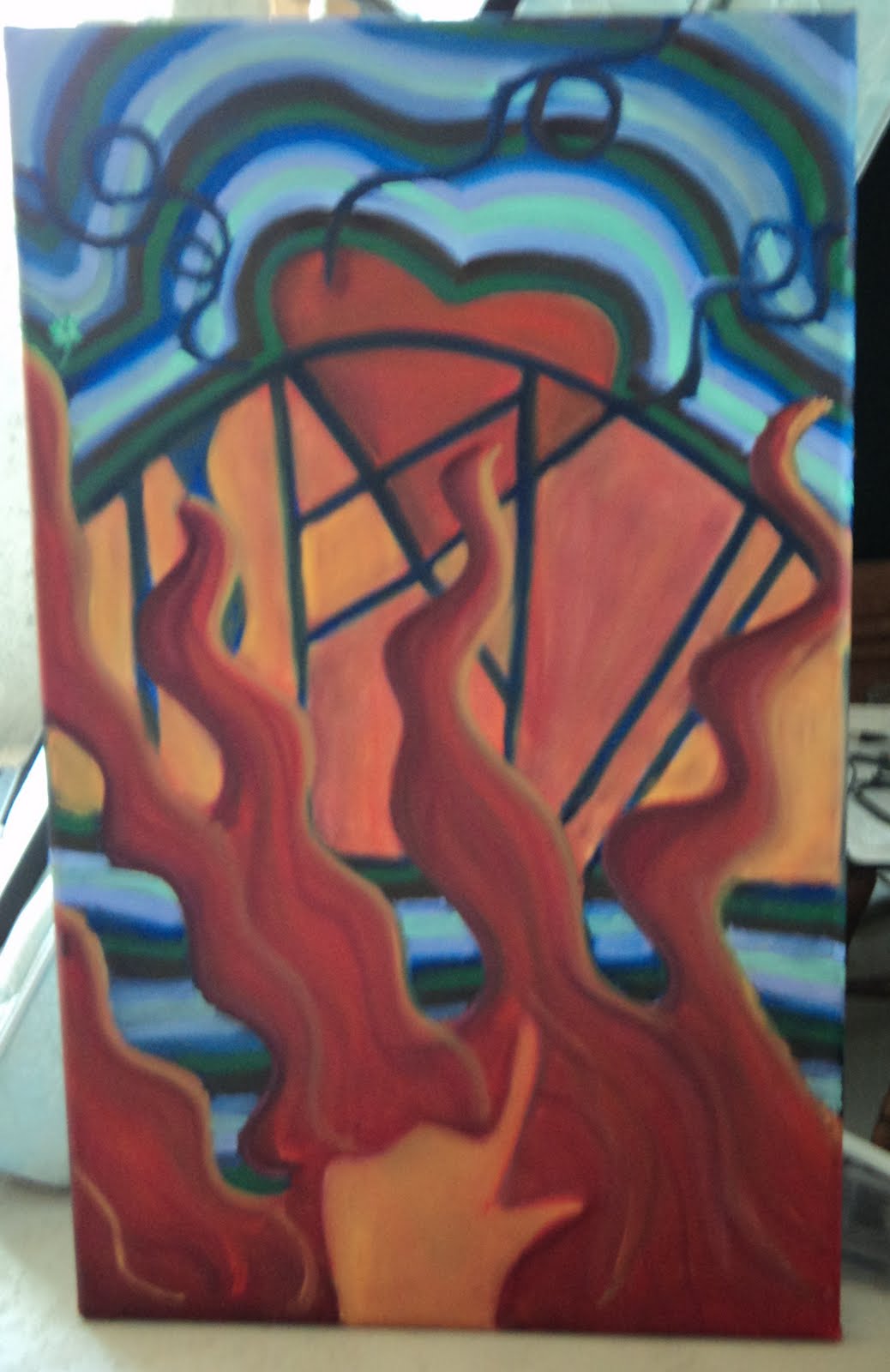
Interpreting the Music, Part II
I painted this while listening to Head over Heels by Tears for Fears:

Monday, April 18, 2011
Salim and His Women
In A Bend in the River by V.S. Naipaul, there are only four female characters, who Salim interacts with throughout his story. He considers these relationships outside of his own family as "special and limited" (170). We are told very little of the other women in his life, such as his mother and sisters, making it seem they didn't really matter in his upbringing and views on women. Salim views Zabeth, Yvette, Shoba, and Kareisha in different ways and they surprise him as they change his mind and his expectations of them.
Salim "treats" Zabeth as a "good customer," until Metty tells him she is a sorceress, and then he finds her charming (10). She doesn't threaten him with her feminine ways, only sticking to their business deals. He views their relationship as simple and uncomplicated, knowing it is "useless" for him to try to entice Zabeth with his new stock (6). When she sends her son Ferdinand to be mentored by him, so that he will have a decent future, it irritates Salim by complicating his life (36). He feels this makes their friendship more than just hassle free.
Shoba brings both friendship and sorrow to Salim. After Shoba comforts him after his breakup with Yvette, he says, "I was amazed by her sympathy and wisdom," seeing a change in her "menace" (226). Before the incident with the peroxide, Salim thought of Shoba as "beautiful" (39). When Shoba reveals her "disfigurement" to Salim, Salim sees as someone who "had begun to rot," determined not to end up like her, as he considers Shoba a cautionary tale of vanity (228).
When Salim meets Yvette, he is strongly affected by her physical features (127). When she seduces him, he tries not "lose" himself in his "new" romantic experiences with her, determined to "win" her over (175). He views Yvette as someone he can play emotional and physical games with, a new adventure (183). Yvette tells Raymond, "Women are stupid. But if women weren't stupid the world wouldn't go round," making it seem like she is more clever than she lets on, which seems like this is the turning point in their relationship (186). To Salim, Yvette was an unattainable and emotional unavailable to Salim and he enjoyed the chase, but now that she has revealed herself to him, he starts to drift away from her.
Salim sees Yvette as a possession. During their breakup, Salim feels Yvette is another person "lost" to him, like she is an object he is parting with (219). Salim blames his violent outburst during his break up with Yvette, telling Metty, "she made me spit on her, " leading us to wonder if he is a misogynist or a sociopath (221).
At first, Salim thinks of Yvette as a mother figure, with Raymond as his father. Salim thinks of Yvette and Raymond as his new "family" and believes he needs to make life good for "three of [them]," as to not complicate his life further (215). When Salim returns from England and hears Yvette and Raymond have left, he briefly mentions it, like he has no remorse or sorrow for their departure, like they didn't matter to him in the first place (259).
Salim sees Kareisha as an example of the ideal woman. She is "new" kind of woman to Salim, because she is affectionate and emotionally available (231). At first he doesn't want to marry her and tries to run away from his promise, but she turns out to be his most valuable relationship, even though they haven't "even kissed" (245). He thinks of his relationship with her as "soothing," causing him act "out my man's role a little," not feeling good enough for her (231). It is her talking about Indar's new life that "touches" him, making him finally realize Africa is his home, impacting his future decision to leave England and go back to Africa (244).
Even though he spends most of his story talking about the war in Africa to his identity crisis, it is Zabeth, Yvette, Shoba, and Kareisha who have a strongest impact on Salim. He views them all as unstable and complicated, not having enough strength to keep up with them. Salim sees the women, he has as friends and lovers, as being comforters or bringers of turmoil.
Works Cited
Naipaul, V.S. A Bend in the River. Alfred A. Knopf, Inc. New York: 1979. Print
Salim "treats" Zabeth as a "good customer," until Metty tells him she is a sorceress, and then he finds her charming (10). She doesn't threaten him with her feminine ways, only sticking to their business deals. He views their relationship as simple and uncomplicated, knowing it is "useless" for him to try to entice Zabeth with his new stock (6). When she sends her son Ferdinand to be mentored by him, so that he will have a decent future, it irritates Salim by complicating his life (36). He feels this makes their friendship more than just hassle free.
Shoba brings both friendship and sorrow to Salim. After Shoba comforts him after his breakup with Yvette, he says, "I was amazed by her sympathy and wisdom," seeing a change in her "menace" (226). Before the incident with the peroxide, Salim thought of Shoba as "beautiful" (39). When Shoba reveals her "disfigurement" to Salim, Salim sees as someone who "had begun to rot," determined not to end up like her, as he considers Shoba a cautionary tale of vanity (228).
When Salim meets Yvette, he is strongly affected by her physical features (127). When she seduces him, he tries not "lose" himself in his "new" romantic experiences with her, determined to "win" her over (175). He views Yvette as someone he can play emotional and physical games with, a new adventure (183). Yvette tells Raymond, "Women are stupid. But if women weren't stupid the world wouldn't go round," making it seem like she is more clever than she lets on, which seems like this is the turning point in their relationship (186). To Salim, Yvette was an unattainable and emotional unavailable to Salim and he enjoyed the chase, but now that she has revealed herself to him, he starts to drift away from her.
Salim sees Yvette as a possession. During their breakup, Salim feels Yvette is another person "lost" to him, like she is an object he is parting with (219). Salim blames his violent outburst during his break up with Yvette, telling Metty, "she made me spit on her, " leading us to wonder if he is a misogynist or a sociopath (221).
At first, Salim thinks of Yvette as a mother figure, with Raymond as his father. Salim thinks of Yvette and Raymond as his new "family" and believes he needs to make life good for "three of [them]," as to not complicate his life further (215). When Salim returns from England and hears Yvette and Raymond have left, he briefly mentions it, like he has no remorse or sorrow for their departure, like they didn't matter to him in the first place (259).
Salim sees Kareisha as an example of the ideal woman. She is "new" kind of woman to Salim, because she is affectionate and emotionally available (231). At first he doesn't want to marry her and tries to run away from his promise, but she turns out to be his most valuable relationship, even though they haven't "even kissed" (245). He thinks of his relationship with her as "soothing," causing him act "out my man's role a little," not feeling good enough for her (231). It is her talking about Indar's new life that "touches" him, making him finally realize Africa is his home, impacting his future decision to leave England and go back to Africa (244).
Even though he spends most of his story talking about the war in Africa to his identity crisis, it is Zabeth, Yvette, Shoba, and Kareisha who have a strongest impact on Salim. He views them all as unstable and complicated, not having enough strength to keep up with them. Salim sees the women, he has as friends and lovers, as being comforters or bringers of turmoil.
Works Cited
Naipaul, V.S. A Bend in the River. Alfred A. Knopf, Inc. New York: 1979. Print
Sunday, April 17, 2011

Friday, April 15, 2011
A Bend in the River Units 12-17
In Units 12 through 17 of A Bend in the River by V.S. Naipaul, we get more of the other character's back stories. Yvette tells Salim how she met Raymond for the first time and her strained interactions with the President, how she offended him. Raymond releases a book of the President's speeches, which is censored by the publisher. This leads to the Youth Guards marching the streets with the books.
The President disbands the Youth Guard. Metty and Salim are "harassed" by the police for being Arabs. Riots sweep the towns and the Capitol and the statues are "smashed." Metty brings Salim a leaflet written by the former Youth Guard, called "The Ancestors Shriek," saying the President is the "enemy." Shoba's father dies and she goes into hiding, cutting off contact with Salim. Shoba reveals to Salim, she had her face bleached to make the skin lighter and shows him her disfigured face.
Salim admits that he enjoys dinner with Yvette and Raymond, feeling like he is a part of their "family." Salim tries to distance himself from Yvette until they break up. Nazruddin writes to Salim, telling him he is leaving Africa to move to Canada. Nazruddin writes a year later, telling him, he is leaving Canada to move to England. Salim flies to London to visit Nazruddin and becomes engaged to Kareisha, Nazruddin's daughter. She tells him what Indar has been up to. Salim leaves to go back to Africa, via Brussels, realizing he belongs in Africa.
Salim goes back to Africa. Metty tells the President has taken control of his shop and given it to Citizen Theotime. Salim becomes the manager of the shop and the chauffeur for Theo. He also learns Raymond and Yvette have left Africa. Work becomes a "hateful place" for both Salim and Metty. Metty believes Salim has "failed" him. Salim is arrested, and Ferdinand, being an Commissioner, visits him, telling Salim, he "must go" before the President visits, and buys him a steamer ticket out of town.
Throughout the turmoil, Salim struggles with his identity. He doesn't believe he is just an Arab or an African. He feels like he doesn't belong anywhere, and has no sense of purpose. He keeps calling himself, "lost." It's interesting as characters leave and head off into another job or location, Salim wishes it was him, who was having a new adventure. It feels like he has "the grass is greener" syndrome, that if he just moved somewhere else, he would be a better person. When he goes to London and feels displaced, is when he finally realizes where he is or where he is from, doesn't matter. He can be the same person anywhere. It's unfortunate that the country he finally chooses to belong to, doesn't feel he belongs either and tortures him for it.
The President disbands the Youth Guard. Metty and Salim are "harassed" by the police for being Arabs. Riots sweep the towns and the Capitol and the statues are "smashed." Metty brings Salim a leaflet written by the former Youth Guard, called "The Ancestors Shriek," saying the President is the "enemy." Shoba's father dies and she goes into hiding, cutting off contact with Salim. Shoba reveals to Salim, she had her face bleached to make the skin lighter and shows him her disfigured face.
Salim admits that he enjoys dinner with Yvette and Raymond, feeling like he is a part of their "family." Salim tries to distance himself from Yvette until they break up. Nazruddin writes to Salim, telling him he is leaving Africa to move to Canada. Nazruddin writes a year later, telling him, he is leaving Canada to move to England. Salim flies to London to visit Nazruddin and becomes engaged to Kareisha, Nazruddin's daughter. She tells him what Indar has been up to. Salim leaves to go back to Africa, via Brussels, realizing he belongs in Africa.
Salim goes back to Africa. Metty tells the President has taken control of his shop and given it to Citizen Theotime. Salim becomes the manager of the shop and the chauffeur for Theo. He also learns Raymond and Yvette have left Africa. Work becomes a "hateful place" for both Salim and Metty. Metty believes Salim has "failed" him. Salim is arrested, and Ferdinand, being an Commissioner, visits him, telling Salim, he "must go" before the President visits, and buys him a steamer ticket out of town.
Throughout the turmoil, Salim struggles with his identity. He doesn't believe he is just an Arab or an African. He feels like he doesn't belong anywhere, and has no sense of purpose. He keeps calling himself, "lost." It's interesting as characters leave and head off into another job or location, Salim wishes it was him, who was having a new adventure. It feels like he has "the grass is greener" syndrome, that if he just moved somewhere else, he would be a better person. When he goes to London and feels displaced, is when he finally realizes where he is or where he is from, doesn't matter. He can be the same person anywhere. It's unfortunate that the country he finally chooses to belong to, doesn't feel he belongs either and tortures him for it.
Wednesday, April 13, 2011


Monday, April 11, 2011


A Bend in the River Units 5-11
In Units 5 through 11 of A Bend in the River by V.S. Naipaul, war between the locals and the invaders erupts in Salim's town. There are warrior armies with guns being taken over by the President's armies. Father Huisman is killed and "mutilated." Mahesh opens a Bigburger, which becomes successful. Salim finds out Metty has fathered a baby with an African woman and feels he has "lost" Metty. Salim reconnects with his friend, Indar. Salim doesn't seem to care for the President and believes the Domain is a "waste and foolishness."
Salim goes to a dinner party at the house of Yvette and Raymond. Raymond is a historian who works with the President. Raymond tells his dinner guests, "It takes an African to rule Africa," since the people don't seem to take kind to the European outsiders. Salim becomes "obsessed" with Yvette, starting an affair with her. Indar tells Salim about his past in England, where he was rejected for a job with the Indian High Commission because he had "divided loyalties," being a citizen of Africa. Ferdinand leaves to become a cadet, and takes a steamer with Indar to the capitol.
Salim shows us the effects of war and colonization on his town, as being tense and uncertain. He envies Ferdinand for the opportunity to leave, calling him a "lucky man moving on to richer experience." He also wishes he could be like Indar, travel anywhere and feel at home, "being himself." It's interesting Salim seems surprised to find a "new need," with falling in love with Yvette. It dawns on him, that all he has been looking for, is security instead of romance.
Salim goes to a dinner party at the house of Yvette and Raymond. Raymond is a historian who works with the President. Raymond tells his dinner guests, "It takes an African to rule Africa," since the people don't seem to take kind to the European outsiders. Salim becomes "obsessed" with Yvette, starting an affair with her. Indar tells Salim about his past in England, where he was rejected for a job with the Indian High Commission because he had "divided loyalties," being a citizen of Africa. Ferdinand leaves to become a cadet, and takes a steamer with Indar to the capitol.
Salim shows us the effects of war and colonization on his town, as being tense and uncertain. He envies Ferdinand for the opportunity to leave, calling him a "lucky man moving on to richer experience." He also wishes he could be like Indar, travel anywhere and feel at home, "being himself." It's interesting Salim seems surprised to find a "new need," with falling in love with Yvette. It dawns on him, that all he has been looking for, is security instead of romance.
Wednesday, April 6, 2011


Tuesday, April 5, 2011
Interpreting the Music, Part I
I painted this while listening to Head over Heels by Tears for Fears:

Monday, April 4, 2011


Friday, April 1, 2011
A Bend in the River Units 1-4
In Units 1 through 4 of A Bend in the River by V.S. Naipaul, we are introduced to a mercantile shop runner named Mr. Salim. He is an Arabic man who grew up on the east coast of Africa in a Muslim family. He was given the shop by a man named Nazruddin, who wants Salim to marry his daughter, but Salim sees as an opportunity to break his "commitment." Salim has one regular customer named Zabeth, a sorceress who makes herself smell bad, and lives in a hidden village. Zabeth has a teenage son named Ferdinand who she sends to Salim, to get educated. While Salim is taking care of Ferdinand, he is taking care of boy named Metty from his own village. Salim tries to track down Father Huismans, the Christian priest who runs the local school, after Ferdinand steals a book. When he finally catches up to him, Father Huismans shows Salim his African masks he has "collected."
Naipaul begins the book by telling us, "The world is what it is; men who are nothing, who allow themselves to become nothing, have no place in it." The book is very philosophical, with most of the characters trying to find their identity and where they belong in a nation that is changing.
Salim shows the most ambition, telling us, "the greater the discouragements of the journey, the keener I was to press on and embrace my new life." He wants the boys in his care to be successful as well. Salim's overall philosophy is "detaching" himself "from a familiar scene and trying to consider if as from a distance," which he proves by observing the people who come in and out of his shop as a way for the reader to get to know the characters well.
Naipaul begins the book by telling us, "The world is what it is; men who are nothing, who allow themselves to become nothing, have no place in it." The book is very philosophical, with most of the characters trying to find their identity and where they belong in a nation that is changing.
Salim shows the most ambition, telling us, "the greater the discouragements of the journey, the keener I was to press on and embrace my new life." He wants the boys in his care to be successful as well. Salim's overall philosophy is "detaching" himself "from a familiar scene and trying to consider if as from a distance," which he proves by observing the people who come in and out of his shop as a way for the reader to get to know the characters well.
Believing Eyes
In The English Patient by Michael Ondaatje, there are several references to eyes. When Katherine is reading the story of Candaules from The Histories, she quotes, "Men's ears are less apt of belief than their eyes," saying our eyes are a powerful seeing tool (232). Each character in The English Patient mostly use their eyes to decide if the things around them are trustworthy.
Almásy communicates with Hana through his eyes when he cannot speak, watching her every move. He reveals to Caravaggio, he got Hana to read to him as a way to "get her to communicate" back (253). When he wants to stop reliving memories of the past, he has to "lock his eyes" onto Hana's face, to focus on the present (4). He studies the physical features of Hana and Katherine while they read to him, wanting to "rest" his eyes (236). While Katherine is "studying him," he also watches her for "something that would give her away," not wanting to trust her (145).
Caravaggio uses his eyes as a shield to disguise himself from his criminal activities. He believes his "eyes are faultless, clear as any river, unimpeachable in the landscape," believing his eyes will make him come across as a decent man (39). Caravaggio uses his eyes to study people while they talk. When Almásy catches Caravaggio staring at him, silently, he asks "am I just a book? Something to be read?" (253).
Hana uses her eyes to read books. Reading books is "the only door out of her cell"(7). Her eyes are her escape from he real world and the horrors around her. While she is treating soldier's wounds, she closes "her eyes against the world around her," using her eyes as a shield (49). She doesn't like looking at herself, into her own eyes, so she "removed all mirrors" vowing to "never" look "at herself in mirrors again" (50). She believes "a novel is mirror walking down a road," and she reads to study worlds she can't live in (91).
Like Almásy, Hana uses her eyes to study people's faces, trying to read their sincerity. She watches Kip while he is sleeping, trying to study "the gnats of electricity in his hair," almost as if she is trying to memorize everything about him (218). She uses Kip's face and eyes as a relaxation point for her moods. Her eyes "darted around and then were still when she faced Kip," calming her anxiety (113).
Kip uses his eyes as radar, a way to search. When he first arrives at the villa, "his eyes took in the room before they took her in, swept across it like a spray of radar," falling in love with Hana at first sight. (76). He uses his eyes as weapons against bombs. He reveals he came to Italy "with eyes that tried to see everything except what was temporary and human," keeping his focus on his job (219). He doesn't read books because he is "able to pinpoint villains with too much ease" (111).
While he is searching for bombs, his eyes locate "the choreography of inanimate objects for the quarter-mile around him," as he as been trained to do (87). When Kip's brother believes he is foolish for "trusting the English", he says to him, repeatedly, "one day you will open your eyes," trying to get him to focus on the politics behind the war and not just the battle itself (217).
Kip doesn't trust the eyes of others. "When someone speaks he looks at a mouth" to tell him the truth, believing eyes can fool him (219). When he looks into Hana's eyes, he doesn't "register what colour they are," focusing on the person she is, behind the eyes (219). He uses his own eyes as a way to shield off people from getting to close. Like Hana, he also doesn't have any mirrors (219). Hana believes Kip is the most "vulnerable" when he has his "eyes closed," letting down the walls blocking him from sharing everything with her. (217).
The narrator in the novel tells us, our eyes give us a reflection, the opportunity to "become vain with the names we own, our claims to have been the first eyes" (142). As humans, we use our eyes to read, watch, to communicate, and to study the world around us. We can also use our eyes to deceive or disguise our true selves. Like the characters in the novel, our eyes reveal our truths, our flaws, and our identity.
Works Cited
Ondaatje, Michael. The English Patient. Vintage International. New York: 1992. Print
Almásy communicates with Hana through his eyes when he cannot speak, watching her every move. He reveals to Caravaggio, he got Hana to read to him as a way to "get her to communicate" back (253). When he wants to stop reliving memories of the past, he has to "lock his eyes" onto Hana's face, to focus on the present (4). He studies the physical features of Hana and Katherine while they read to him, wanting to "rest" his eyes (236). While Katherine is "studying him," he also watches her for "something that would give her away," not wanting to trust her (145).
Caravaggio uses his eyes as a shield to disguise himself from his criminal activities. He believes his "eyes are faultless, clear as any river, unimpeachable in the landscape," believing his eyes will make him come across as a decent man (39). Caravaggio uses his eyes to study people while they talk. When Almásy catches Caravaggio staring at him, silently, he asks "am I just a book? Something to be read?" (253).
Hana uses her eyes to read books. Reading books is "the only door out of her cell"(7). Her eyes are her escape from he real world and the horrors around her. While she is treating soldier's wounds, she closes "her eyes against the world around her," using her eyes as a shield (49). She doesn't like looking at herself, into her own eyes, so she "removed all mirrors" vowing to "never" look "at herself in mirrors again" (50). She believes "a novel is mirror walking down a road," and she reads to study worlds she can't live in (91).
Like Almásy, Hana uses her eyes to study people's faces, trying to read their sincerity. She watches Kip while he is sleeping, trying to study "the gnats of electricity in his hair," almost as if she is trying to memorize everything about him (218). She uses Kip's face and eyes as a relaxation point for her moods. Her eyes "darted around and then were still when she faced Kip," calming her anxiety (113).
Kip uses his eyes as radar, a way to search. When he first arrives at the villa, "his eyes took in the room before they took her in, swept across it like a spray of radar," falling in love with Hana at first sight. (76). He uses his eyes as weapons against bombs. He reveals he came to Italy "with eyes that tried to see everything except what was temporary and human," keeping his focus on his job (219). He doesn't read books because he is "able to pinpoint villains with too much ease" (111).
While he is searching for bombs, his eyes locate "the choreography of inanimate objects for the quarter-mile around him," as he as been trained to do (87). When Kip's brother believes he is foolish for "trusting the English", he says to him, repeatedly, "one day you will open your eyes," trying to get him to focus on the politics behind the war and not just the battle itself (217).
Kip doesn't trust the eyes of others. "When someone speaks he looks at a mouth" to tell him the truth, believing eyes can fool him (219). When he looks into Hana's eyes, he doesn't "register what colour they are," focusing on the person she is, behind the eyes (219). He uses his own eyes as a way to shield off people from getting to close. Like Hana, he also doesn't have any mirrors (219). Hana believes Kip is the most "vulnerable" when he has his "eyes closed," letting down the walls blocking him from sharing everything with her. (217).
The narrator in the novel tells us, our eyes give us a reflection, the opportunity to "become vain with the names we own, our claims to have been the first eyes" (142). As humans, we use our eyes to read, watch, to communicate, and to study the world around us. We can also use our eyes to deceive or disguise our true selves. Like the characters in the novel, our eyes reveal our truths, our flaws, and our identity.
Works Cited
Ondaatje, Michael. The English Patient. Vintage International. New York: 1992. Print
Monday, March 28, 2011


Friday, March 25, 2011
The English Patient Pages 207-302
In pages 207 through 302 of The English Patient by Michael Ondaatje, the English patient confirms that he is Almasy. Almasy reveals he met Katherine two week after she married Geoffrey, falling in love with her while she read Herodotus with him , and began their affair a year later. He also tells us Madox shot himself while in a church service. When Almasy left the cave to go for help, he was arrested for being a spy in El Taj.
Caravaggio reveals to Almasy that he and Geoffrey worked for British Intelligence and the agency was planning on assassinating him. Kip reveals how fearless he is when it comes to disarming bombs, feeling like he is defending himself like an "animal." When Kip hears about the nuclear bombs hitting Japan, he takes a rifle and threatens to kill Almasy, blaming the British. Kip later leaves the villa and Hana behind, sparing Almasy's life. Fourteen years later, Kip is a married doctor with two children back in India, who wonders where Hana is and if she is happy.
They talk a lot about words and reading. Almasy feels he "has been governed by words" and insists to Caravaggio that "words have power." Almasy tells Caravaggio, the only way he could get Hana "to communicate was to ask her to read to me," breaking down her walls. When Caravaggio interrogates Almasy, he says "Am I just a book? Something to be read?"
The desert is a powerful and important place for Almasy, where he was burned, fell in love, and fought for survival. Almasy realizes, "A man shall be a rivers of water in a dry place," believe in man's effect on nature. Almasy believes the desert is the "theatre of war," "has been raped by war, shelled as if it were just sand, " and it "spoiled Madox."
Caravaggio reveals to Almasy that he and Geoffrey worked for British Intelligence and the agency was planning on assassinating him. Kip reveals how fearless he is when it comes to disarming bombs, feeling like he is defending himself like an "animal." When Kip hears about the nuclear bombs hitting Japan, he takes a rifle and threatens to kill Almasy, blaming the British. Kip later leaves the villa and Hana behind, sparing Almasy's life. Fourteen years later, Kip is a married doctor with two children back in India, who wonders where Hana is and if she is happy.
They talk a lot about words and reading. Almasy feels he "has been governed by words" and insists to Caravaggio that "words have power." Almasy tells Caravaggio, the only way he could get Hana "to communicate was to ask her to read to me," breaking down her walls. When Caravaggio interrogates Almasy, he says "Am I just a book? Something to be read?"
The desert is a powerful and important place for Almasy, where he was burned, fell in love, and fought for survival. Almasy realizes, "A man shall be a rivers of water in a dry place," believe in man's effect on nature. Almasy believes the desert is the "theatre of war," "has been raped by war, shelled as if it were just sand, " and it "spoiled Madox."
Thursday, March 24, 2011


Tuesday, March 22, 2011

Monday, March 21, 2011


Friday, March 11, 2011
Apple Collages, Aztecs, and Interiors
For Art History, we learned about the Incas, the Baroque, and the Aztecs. For Color Theory, we made a collage of red apple using clippings from magazines on bristol board. For Painting I, we finished our interior painting of the art building. For World Literature, I read to page 206 of The English Patient by Michael Ondaatje.
The English Patient Pages 107-203
In pages 107 through 203 of The English Patient by Michael Ondaatje, the backgrounds of Kip and the English patient are revealed. Hana has started a romantic relationship with Kip, while still having feelings for the patient and Caravaggio. The English patient tells us of his time in South Cairo between 1930 and the present, where he was a map maker and how he fell in love with a married woman named Katherine Clifton. After their breakup, Katherine's husband tries to kill them all in a plane crash, but the patient drags Katherine out alive. She dies wounded, in a nearby cave, where he returns three years later. Caravaggio reveals the patient might be a spy from Hungary, instead of English, based on his time in Cairo. Kip reveals his past with destructing bombs and how he got recruited for his job. Kip also reveals his brother was a protester of anything dealing with the English and is in jail.
Caravaggio is the voice of reason in this novel. He talks to the other characters about war and society and doesn't sugar coat the history or the present. Although none of the characters are wealthy, they live in "like the filthy rich in their filthy villas" during a war, so they're pretty well off, in a difficult time, even though their villa is rigged with bombs and falling apart. He finds a gramophone and plays music as a distraction to the chaos they feel outside of their villa. Caravaggio is clearly frustrated with the events of the war, asking "What are we doing in Africa, in Italy?" He believes Kip, Hana, and himself are "free," with no obligations other than to live their own lives the way the choose. He wants to protect Hana and get her out of the country by killing the patient.
Caravaggio is the voice of reason in this novel. He talks to the other characters about war and society and doesn't sugar coat the history or the present. Although none of the characters are wealthy, they live in "like the filthy rich in their filthy villas" during a war, so they're pretty well off, in a difficult time, even though their villa is rigged with bombs and falling apart. He finds a gramophone and plays music as a distraction to the chaos they feel outside of their villa. Caravaggio is clearly frustrated with the events of the war, asking "What are we doing in Africa, in Italy?" He believes Kip, Hana, and himself are "free," with no obligations other than to live their own lives the way the choose. He wants to protect Hana and get her out of the country by killing the patient.
Friday, March 4, 2011
The English Patient: Pages 1-106
In pages 1 through 106 of The English Patient by Michael Ondaatje, we are introduced to four unique characters who are all living at this time at the Villa San Girolamo in Italy during World War II. Hana is a twenty year old reclusive nurse who likes to spend time reading and taking care of the English patient. Hana seems to be in love with all of her houseguests.
David Caravaggio is a thief who got his thumbs cut off, trying to steal a camera which held his photography, and was a friend of Hana's father. The English patient, who remains nameless at this time, whose plane went down in the African desert. He was rescued by members of the Bedouin tribe who used him to find buried weapons. We know little about him, besides the fact he is burned all over his body and wears a hearing aid. Kip, a Sikh, apparently can diffuse bombs.
Hana, so far, is the most interesting to me. The narrator tells us Hana loves the outdoors, because she wants the air to smell of "nothing human," being trapped in a world of blood and death. Hana reminds me of Harriet in Old Gringo. She won't look in the mirror like Harriet and believes a book "is a mirror walking down a road." She constantly is reading, because she "fell upon books as the only door out of her cell," so obviously she doesn't enjoy the sadness of her job. She hasn't made connections, calling every patient she treats, "Buddy," except for the people left in the villa. She feels "safe" in the villa, "half adult and half child," almost like she is playing house. These three men seem to have broken her shell, because deep down she wants attention and love.
David Caravaggio is a thief who got his thumbs cut off, trying to steal a camera which held his photography, and was a friend of Hana's father. The English patient, who remains nameless at this time, whose plane went down in the African desert. He was rescued by members of the Bedouin tribe who used him to find buried weapons. We know little about him, besides the fact he is burned all over his body and wears a hearing aid. Kip, a Sikh, apparently can diffuse bombs.
Hana, so far, is the most interesting to me. The narrator tells us Hana loves the outdoors, because she wants the air to smell of "nothing human," being trapped in a world of blood and death. Hana reminds me of Harriet in Old Gringo. She won't look in the mirror like Harriet and believes a book "is a mirror walking down a road." She constantly is reading, because she "fell upon books as the only door out of her cell," so obviously she doesn't enjoy the sadness of her job. She hasn't made connections, calling every patient she treats, "Buddy," except for the people left in the villa. She feels "safe" in the villa, "half adult and half child," almost like she is playing house. These three men seem to have broken her shell, because deep down she wants attention and love.
Wednesday, March 2, 2011


Sunday, February 20, 2011
The Escape Plan
In The Old Gringo by Carlos Fuentes, the main characters, the old gringo and Harriet, are obsessed with destiny and death. They both have different theories about how they should die and when. None of them seem to be able to just let go and let fate decide when they should die. They feel entitled to being in control of their own mortality and making their own fate. They are afraid of living, using death as an escape.
They believe life's hardships are too painful for them to bear. By crossing over to Mexico, the old gringo is running away from his fear of dying the natural way. He wants to die "with honor" (17). He doesn't want to just commit suicide, because he saw how painful it was to his son, but he is on a reckless mission to die at the hands of others (144). Harriet wants to die "free of humiliation, resentment, guilt, or suspicion" and being in control of her own mind (44). They both expect to be able to make a choice they won't be able to make.
Mexico is used as a final destination, a place representing their dying wishes. We are told several times, "The old gringo came to Mexico to die," seeking euthanasia, and he wanted Pancho Villa to kill him (4). The old gringo goes to Mexico to die fighting for the revolution, knowing the locals hate the gringos, sealing his fate for dying through murder. The old gringo wants to die in the grand way of going out, fighting because "it's not difficult to be brave when you're not afraid to die" (56). He knows his recklessness will cost him his life.
They believe death will bring them mercy from their peril, loneliness, and boredom. The old gringo wants to die, "because everything he loved had died before him" (37). He feels lonely without his relatives, feeling left out, forced to carry the burden of living, when the others have been released from their pain. He says, "Only death can compensate for so much vindictive bile," making death seem like his savior from a painful life (74). The old gringo feels death brought him freedom the moment he "crossing the border," liberating him from his age and life scars (161). The U.S. represents everything bad in the world to him and Harriet. Once he goes to Mexico, he knows his goal of death will be met.
Death represents a good rest for the tired living. To the old gringo, death comes when he cannot fathom living anymore. As he rides through Mexico, "The desert told him that death is nothing more than the exhaustion of the laws of nature: life is the rule of the game, not its exception," making it seem like living and dying are the same (16). When Arroyo wants to kill old gringo, and Harriet intervenes, Arroyo thinks the old gringo "will hate" him if he grants him the chance to live any longer (136). To the old gringo, "dying is simply the last pain," and he would rather feel the pain of dying than the pains of living (176).
Neither of them can face growing older. The old gringo wants to be a "good-looking corpse," free from the signs of wasting away to nothing (199). The old gringo and Harriet avoid looking in the mirrors, because "mirrors were beginning to tell a story that didn't please [Harriet]," leading us to wonder if she is ashamed of her age (57). The old gringo believes early death lets you "escape corruption," leaving them to die as innocents instead of elderly (81). Harriet want to live through her "dreams," because when she dreams, she is "ageless" (111).
While the old gringo succeeds in his escape plan, we don't know if he is better off in the afterlife. We do know Harriet is still miserable, being alive and growing older. Harriet doesn't get her wish and we see what the effects of surviving have done to her. She cannot control her destiny and faces the toughest battle, because she has to remain in a cycle of these events, stuck in remembrance (199). She might as well be dead, because she is going through the motions of life, instead of living.
Works Cited
Fuentes, Carlos. The Old Gringo. New York: Farrar, Straus, and Giroux, 1985. Print.
They believe life's hardships are too painful for them to bear. By crossing over to Mexico, the old gringo is running away from his fear of dying the natural way. He wants to die "with honor" (17). He doesn't want to just commit suicide, because he saw how painful it was to his son, but he is on a reckless mission to die at the hands of others (144). Harriet wants to die "free of humiliation, resentment, guilt, or suspicion" and being in control of her own mind (44). They both expect to be able to make a choice they won't be able to make.
Mexico is used as a final destination, a place representing their dying wishes. We are told several times, "The old gringo came to Mexico to die," seeking euthanasia, and he wanted Pancho Villa to kill him (4). The old gringo goes to Mexico to die fighting for the revolution, knowing the locals hate the gringos, sealing his fate for dying through murder. The old gringo wants to die in the grand way of going out, fighting because "it's not difficult to be brave when you're not afraid to die" (56). He knows his recklessness will cost him his life.
They believe death will bring them mercy from their peril, loneliness, and boredom. The old gringo wants to die, "because everything he loved had died before him" (37). He feels lonely without his relatives, feeling left out, forced to carry the burden of living, when the others have been released from their pain. He says, "Only death can compensate for so much vindictive bile," making death seem like his savior from a painful life (74). The old gringo feels death brought him freedom the moment he "crossing the border," liberating him from his age and life scars (161). The U.S. represents everything bad in the world to him and Harriet. Once he goes to Mexico, he knows his goal of death will be met.
Death represents a good rest for the tired living. To the old gringo, death comes when he cannot fathom living anymore. As he rides through Mexico, "The desert told him that death is nothing more than the exhaustion of the laws of nature: life is the rule of the game, not its exception," making it seem like living and dying are the same (16). When Arroyo wants to kill old gringo, and Harriet intervenes, Arroyo thinks the old gringo "will hate" him if he grants him the chance to live any longer (136). To the old gringo, "dying is simply the last pain," and he would rather feel the pain of dying than the pains of living (176).
Neither of them can face growing older. The old gringo wants to be a "good-looking corpse," free from the signs of wasting away to nothing (199). The old gringo and Harriet avoid looking in the mirrors, because "mirrors were beginning to tell a story that didn't please [Harriet]," leading us to wonder if she is ashamed of her age (57). The old gringo believes early death lets you "escape corruption," leaving them to die as innocents instead of elderly (81). Harriet want to live through her "dreams," because when she dreams, she is "ageless" (111).
While the old gringo succeeds in his escape plan, we don't know if he is better off in the afterlife. We do know Harriet is still miserable, being alive and growing older. Harriet doesn't get her wish and we see what the effects of surviving have done to her. She cannot control her destiny and faces the toughest battle, because she has to remain in a cycle of these events, stuck in remembrance (199). She might as well be dead, because she is going through the motions of life, instead of living.
Works Cited
Fuentes, Carlos. The Old Gringo. New York: Farrar, Straus, and Giroux, 1985. Print.
Friday, February 18, 2011
Old Gringo
In Units 1 through 12 of Old Gringo by Carlos Fuentes, we are first introduced to an American tutor named Harriet Wilson who is remembering the deceased Old Gringo in a flashback. The Old Gringo is a retired American writer and Calvinist with a death wish, who comes to Chihuahua on a horse, falls for Harriet, and gets caught in the middle of the Mexican revolution. So far we've learn the old gringo's main reasons for wanting to die are because "everything he loved had died before him" and he goes to Mexico because he doesn't "have any frontiers left to cross in his own country." He fights along side "General" Tomas Arroyo, who insists on burning the haciendas and gorilla warfare, because the old gringo thinks the United States is the "sweet land of felony" and "corruption."
The characters in these units talk a lot about bravery and how brave the old gringo is for helping them fight. They call him everything from a "saint," a "holy man." He was described as "too brave for his own good" and he says "it's not difficult to be brave when you're not afraid to die." Is the old gringo brave for wanting to die by his own terms? Or is it cowardice to run away and want to die in life's difficulties?
There is also a lot of references to mirrors. Why are the old gringo and Harriet obsessed with avoiding mirrors? Harriet doesn't like them, because "mirrors were beginning to tell a story that didn't please her," leading us to wonder if she is ashamed of her age or her American heritage. She is haunted by the old gringo asking her, "Did you look at yourself in the mirror?" The old man didn't see the mirrors, "because he had eyes only for Miss Harriet."
The characters in these units talk a lot about bravery and how brave the old gringo is for helping them fight. They call him everything from a "saint," a "holy man." He was described as "too brave for his own good" and he says "it's not difficult to be brave when you're not afraid to die." Is the old gringo brave for wanting to die by his own terms? Or is it cowardice to run away and want to die in life's difficulties?
There is also a lot of references to mirrors. Why are the old gringo and Harriet obsessed with avoiding mirrors? Harriet doesn't like them, because "mirrors were beginning to tell a story that didn't please her," leading us to wonder if she is ashamed of her age or her American heritage. She is haunted by the old gringo asking her, "Did you look at yourself in the mirror?" The old man didn't see the mirrors, "because he had eyes only for Miss Harriet."
In Units 13 through 23 of Old Gringo by Carlos Fuentes, Harriet offers herself to Arroyo in exchange for the protection of Old Gringo. La Luna tells Harriet about her life in an abusive marriage and how the rebels killed her husband. The Old Gringo tells Harriet, "you haven't saved me from anything." He tells her he wants to "be killed by Pancho Villa himself." The Old Gringo kisses Harriet, with both of them using each other as a replacement. The Old Gringo is shot in the back by Arroyo and killed. Harriet scorns Arroyo, revealing he is really the child of "Miranda," and telling him she will never forgive him.
When Pancho Villa comes to Camargo, Harriet claims the Old Gringo as her father, wanting to take his body back to America for "a Christian burial." Villa has Arroyo bring the body to Camargo, where they prop the body up, shooting it in the front and then Villa orders Arroyo to give the body a "coup de grace". Afterwards, Villa executes Arroyo and La Luna buries him in the desert, "where nothing more would ever be heard of him." Incencio Mansalvo escorts the body of the Old Gringo with Harriet to the U.S. border in Juarez, where Incencio tells Harriet, "Why didn't you fall in love with me? My General would still be alive today." Harriet is interviewed by a reporter from an American newspaper, asking her if she wants to save Mexico, and she says, "I want to learn to live with Mexico. I don't want to save it." The book ends the way it begins, with Harriet remembering these events.
The characters talk a lot of home, trying to define it, why they left home, and why they did or did not want to return. It seems like each of the main characters are stuck in the past, with death as the only escape. They don't look in the mirror, for fear of seeing their faces getting older. They don't seem happier, even though they are running away from their pasts.
The Old Gringo believes leaving America, was a liberation from all his problems back in the states and he feels "young again, when lack of experience had prevented comparisons." It almost seems like he left his past at the border, even though he keeps bringing it up with Harriet. Old Gringo tells Harriet, he once wrote, "Events have been matching themselves since the beginning of Time so that I may die here," knowing the only reason Mexico goes to war "was always the Gringos."
Arroyo resents the U.S. for evolving, and breaking "all tradition just for the sake of it, as if there were good things only in the future . . ." Yet he is trying to change his destiny. Arroyo comes back "to destroy" his forced destiny "so that no one ever again has the choice that was mine in Mexico." Arroyo says, "Pancho Villa hates anyone who thinks about going home," as a setup for Villa killing him.
Harriet believes her home "is a memory. The only true memory: for memory is our home," allowing us to know why she is caught up in remembering. She feels "condemned" having to escort the Old Gringo's back to the states, telling herself "she had to show Arroyo that no one has the right to go home again." She is only one who cannot escape.
When Pancho Villa comes to Camargo, Harriet claims the Old Gringo as her father, wanting to take his body back to America for "a Christian burial." Villa has Arroyo bring the body to Camargo, where they prop the body up, shooting it in the front and then Villa orders Arroyo to give the body a "coup de grace". Afterwards, Villa executes Arroyo and La Luna buries him in the desert, "where nothing more would ever be heard of him." Incencio Mansalvo escorts the body of the Old Gringo with Harriet to the U.S. border in Juarez, where Incencio tells Harriet, "Why didn't you fall in love with me? My General would still be alive today." Harriet is interviewed by a reporter from an American newspaper, asking her if she wants to save Mexico, and she says, "I want to learn to live with Mexico. I don't want to save it." The book ends the way it begins, with Harriet remembering these events.
The characters talk a lot of home, trying to define it, why they left home, and why they did or did not want to return. It seems like each of the main characters are stuck in the past, with death as the only escape. They don't look in the mirror, for fear of seeing their faces getting older. They don't seem happier, even though they are running away from their pasts.
The Old Gringo believes leaving America, was a liberation from all his problems back in the states and he feels "young again, when lack of experience had prevented comparisons." It almost seems like he left his past at the border, even though he keeps bringing it up with Harriet. Old Gringo tells Harriet, he once wrote, "Events have been matching themselves since the beginning of Time so that I may die here," knowing the only reason Mexico goes to war "was always the Gringos."
Arroyo resents the U.S. for evolving, and breaking "all tradition just for the sake of it, as if there were good things only in the future . . ." Yet he is trying to change his destiny. Arroyo comes back "to destroy" his forced destiny "so that no one ever again has the choice that was mine in Mexico." Arroyo says, "Pancho Villa hates anyone who thinks about going home," as a setup for Villa killing him.
Harriet believes her home "is a memory. The only true memory: for memory is our home," allowing us to know why she is caught up in remembering. She feels "condemned" having to escort the Old Gringo's back to the states, telling herself "she had to show Arroyo that no one has the right to go home again." She is only one who cannot escape.
Wednesday, February 16, 2011


Tuesday, February 15, 2011


Monday, February 14, 2011


Friday, February 11, 2011
The Rule Breakers
Patrick White's Voss defines the rules and regulations of women and men in this Australian society. Even this remote colony in the nineteenth century has to deal with high society's expectations spoiling their freedom in undiscovered land. Laura and Voss struggle with being outsiders, because of their personal philosophies do not match up with society's expectations. Laura and Voss find each other because they are the rule breakers.
Men and women look down on Laura for being educated. Mrs. Pringle believes Laura's possession of "brains" is "not to be trusted," fearing young women who are educated as a sign of the apocalypse (51). Laura reads "a great deal out of such books until she feels her "mind is complete", so she can have "private" thoughts, only way Laura is able to hear the philosophies of others, being able to devise her own opinions, and passing on her knowledge to her future students at the school she inherits (3).
Belle and Laura are supposed to rely on their looks to get a husband. When Tom Radclyffe asks Laura what she is thinking, Laura says to him, "I am sorry, Tom, to have given you literally what you asked for. You must take care not to run the risk in the future" (76). Tom views Laura as a challenge, and decides to court her beautiful but dimwitted cousin Belle instead. When Voss first meets Laura, we are led to believe beauty is not "necessary to him," because he wants someone, like Laura, who will intellectually challenge him (8).
The women cannot choose their friends. Men like Judd and Turner can't hide their distaste for Voss as a leader, and are able leave the expedition without thinking of societal consequences. On the other hand, women like Mrs. Bonner decide "it would be politic to keep [Mrs. Pringle] as a friend," even though she doesn't like her, because of the social hierarchy (292). Belle and Laura seem to have the only honest friendship as women, "greedy for each other's love" even though they are complete opposites (421). Belle "resents" Laura out of love because she knows "she was not, and never would be of her cousin's class" (438). They both envy the other's different aspects of life, such as companionship and knowledge.
The women are supposed to wait at home and not explore the harsh lands of Australia like the men on the expedition. Laura says to Voss, "Oh, I know I am ignorant [about the country]. Women are, and men invariably make it clear to them," which makes her seem jealous she doesn't get the same opportunities of adventure like the men, because she is forced to play the naive girl role when traveling through the unknown (5). Laura seems mystified by the dangers of the land, but she does not "afraid," or believes Voss is afraid either (22).
The people are expected to be religious, praying and going to church every Sunday to show their faith in God. Laura and Voss both questioned God's existence, are prideful enough to be "damned", and Voss hates "humility" (83). If Laura had gone to church without faking a headache, meeting Voss wouldn't have had the same impact on her. Their meaningful conversations about God brought them closer before Voss left on the expedition, because they were able to figure out who the other one was deep down.
If Laura and Voss followed the rules placed upon them by society, Laura and Voss's relationships would mirror the unhappy Pringles, the Bonners, and the Radclyffes. They would not be able to communicate, because they are hiding their true selves from the backlash of judgments. Because Laura and Voss don't follow the rules, they are able to make a deeper connection with each other more than any other man and woman in this society.
Works Cited
White Patrick. Voss. New York: Penguin, 1957. Print.
Men and women look down on Laura for being educated. Mrs. Pringle believes Laura's possession of "brains" is "not to be trusted," fearing young women who are educated as a sign of the apocalypse (51). Laura reads "a great deal out of such books until she feels her "mind is complete", so she can have "private" thoughts, only way Laura is able to hear the philosophies of others, being able to devise her own opinions, and passing on her knowledge to her future students at the school she inherits (3).
Belle and Laura are supposed to rely on their looks to get a husband. When Tom Radclyffe asks Laura what she is thinking, Laura says to him, "I am sorry, Tom, to have given you literally what you asked for. You must take care not to run the risk in the future" (76). Tom views Laura as a challenge, and decides to court her beautiful but dimwitted cousin Belle instead. When Voss first meets Laura, we are led to believe beauty is not "necessary to him," because he wants someone, like Laura, who will intellectually challenge him (8).
The women cannot choose their friends. Men like Judd and Turner can't hide their distaste for Voss as a leader, and are able leave the expedition without thinking of societal consequences. On the other hand, women like Mrs. Bonner decide "it would be politic to keep [Mrs. Pringle] as a friend," even though she doesn't like her, because of the social hierarchy (292). Belle and Laura seem to have the only honest friendship as women, "greedy for each other's love" even though they are complete opposites (421). Belle "resents" Laura out of love because she knows "she was not, and never would be of her cousin's class" (438). They both envy the other's different aspects of life, such as companionship and knowledge.
The women are supposed to wait at home and not explore the harsh lands of Australia like the men on the expedition. Laura says to Voss, "Oh, I know I am ignorant [about the country]. Women are, and men invariably make it clear to them," which makes her seem jealous she doesn't get the same opportunities of adventure like the men, because she is forced to play the naive girl role when traveling through the unknown (5). Laura seems mystified by the dangers of the land, but she does not "afraid," or believes Voss is afraid either (22).
The people are expected to be religious, praying and going to church every Sunday to show their faith in God. Laura and Voss both questioned God's existence, are prideful enough to be "damned", and Voss hates "humility" (83). If Laura had gone to church without faking a headache, meeting Voss wouldn't have had the same impact on her. Their meaningful conversations about God brought them closer before Voss left on the expedition, because they were able to figure out who the other one was deep down.
If Laura and Voss followed the rules placed upon them by society, Laura and Voss's relationships would mirror the unhappy Pringles, the Bonners, and the Radclyffes. They would not be able to communicate, because they are hiding their true selves from the backlash of judgments. Because Laura and Voss don't follow the rules, they are able to make a deeper connection with each other more than any other man and woman in this society.
Works Cited
White Patrick. Voss. New York: Penguin, 1957. Print.
Thursday, February 10, 2011

Tuesday, February 8, 2011


Monday, February 7, 2011


Friday, February 4, 2011
Cold Winds, Renaissance, and Grids
It was pretty much a normal week despite the cold winds up at Weber. Walking through them the last couple of days has not been fun.
My Dad is a huge Taylor Swift fan and keeps asking us when she is coming in concert to SLC. My Mom got him a Taylor Swift calendar yesterday and put it on his office on the bulletin board as a surprise.
For Art History, we finished Gothic architecture and started Renaissance.
For Color Theory, we did a grid painting of Elizabeth Taylor using color temperature.
For Painting I, I finished my glass still life and worked on smaller abstract painting based on a photo of the Journey to Atlantis at Sea World Orlando.
For World Literature, we finished reading Voss and our professor had us read about the U.S. relations with Mexico.
My Dad is a huge Taylor Swift fan and keeps asking us when she is coming in concert to SLC. My Mom got him a Taylor Swift calendar yesterday and put it on his office on the bulletin board as a surprise.
For Art History, we finished Gothic architecture and started Renaissance.
For Color Theory, we did a grid painting of Elizabeth Taylor using color temperature.
For Painting I, I finished my glass still life and worked on smaller abstract painting based on a photo of the Journey to Atlantis at Sea World Orlando.
For World Literature, we finished reading Voss and our professor had us read about the U.S. relations with Mexico.
Voss
In the novel, Voss by Patrick White, there are two unique main characters who are both searching for something, under the constraints of others. They remind me of the movie, Australia, because the two main characters are very similar to Voss and Laura. Laura and Voss are total opposites, exchanging witty banter similar to Darcy and Elizabeth in Pride & Prejudice, with interesting viewpoints coming from each background.
Voss, the German, seems like a naturalist and a daydreamer, relying on the world outside of people, his "sight," and his feelings to be his "map." He seems not to have been brought up in proper society, not having use for "beautiful" women, fancy things, saying he is "sufficient in himself." When Laura makes a jab at men oppressing women, he says to Laura, "I do not always understand very well, not all things." Mrs. Bonner describe him as "lost. His eyes cannot find their way," making him seem like a wanderer with no final destination.
Laura Trevelyan seems like a typical pampered "flawless" girl, who on her "beautiful" surface seems happy spending her time with "embroidery" and being "nice" to her servants, but not liking them. Underneath she is a woman wanting to express herself but is afraid to branch out. Even though she reads until "her mind [seems] to be complete," she is also "lost," unable to find her own opinions. She says, "I don't know," when questioned, but I'm sure there is an unexpressed opinion running through her mind. Both Laura and Voss seem restless to break out from the lives they are living.
Voss, the German, seems like a naturalist and a daydreamer, relying on the world outside of people, his "sight," and his feelings to be his "map." He seems not to have been brought up in proper society, not having use for "beautiful" women, fancy things, saying he is "sufficient in himself." When Laura makes a jab at men oppressing women, he says to Laura, "I do not always understand very well, not all things." Mrs. Bonner describe him as "lost. His eyes cannot find their way," making him seem like a wanderer with no final destination.
Laura Trevelyan seems like a typical pampered "flawless" girl, who on her "beautiful" surface seems happy spending her time with "embroidery" and being "nice" to her servants, but not liking them. Underneath she is a woman wanting to express herself but is afraid to branch out. Even though she reads until "her mind [seems] to be complete," she is also "lost," unable to find her own opinions. She says, "I don't know," when questioned, but I'm sure there is an unexpressed opinion running through her mind. Both Laura and Voss seem restless to break out from the lives they are living.
In chapters five through eight of Voss by Patrick White, the Osprey departs and lands in Newcastle. When they arrive in Newcastle, they are invited to stay with the Sanderson's, even though Voss would prefer to sleep outside. Voss sees aboriginals for the first time and feels like all men are "good." Voss meets Mr. Judd, a criminal, joining the expedition. Voss writes Laura a letter, asking for her hand in marriage. The explorers go to Jildra and meet Mr. Brendan Boyle, a judgmental man.
In his letters to Laura, Voss communicates in ways he cannot with his fellow men. He bares his soul, calling his meeting her, a gift of "destiny." His letter leaves Laura "confused," but willing to accept. Voss receives Laura's letter, a positive response to his proposal. Voss writes Laura a letter, admitting that his love for her is his "weakness" and she makes him have "humility." Dugald, a black man, tears up the letter on the way to Mr. Boyle.
Voss is definitely misunderstood by the men who go on the journey with him, especially Palfreyman. Palfreyman describes Voss as "the ugly rock upon which truth must batter itself to survive." They seem to all trust his judgment, even though they questioned his methods, because his strong will has convinced "them of the safety of the money they had invested in him." White shows us the awkward exchanges between Voss and Sanderson as a way to show us how Voss feels uncomfortable being around society and would rather have the "complete freedom" of nature.
In his letters to Laura, Voss communicates in ways he cannot with his fellow men. He bares his soul, calling his meeting her, a gift of "destiny." His letter leaves Laura "confused," but willing to accept. Voss receives Laura's letter, a positive response to his proposal. Voss writes Laura a letter, admitting that his love for her is his "weakness" and she makes him have "humility." Dugald, a black man, tears up the letter on the way to Mr. Boyle.
Voss is definitely misunderstood by the men who go on the journey with him, especially Palfreyman. Palfreyman describes Voss as "the ugly rock upon which truth must batter itself to survive." They seem to all trust his judgment, even though they questioned his methods, because his strong will has convinced "them of the safety of the money they had invested in him." White shows us the awkward exchanges between Voss and Sanderson as a way to show us how Voss feels uncomfortable being around society and would rather have the "complete freedom" of nature.
In chapters 9 through 12 of Voss by Patrick White, Rose dies after giving birth to a girl who she names Mercy, leaving Laura to bond with the child. Mrs. Bonner tries to give Mercy to a childless couple, the Asbolds, but Mrs. Asbold refuses to take her, seeing how much Laura loves the baby. Laura's family attends a ball and wedding of Belle Bonner, who gets married to Radcliffe. Voss and crew encounter several storms, where they have to hide out in caves. Voss is forced to shoot and kill his dog Gyp, because of lack of sheep. Palfreyman reveals his history with his crazy and deformed sister. Palfreyman is killed by a spear of an Aboriginal during an attack on their camp. Judd, Turner, and Angus leave Voss's company to venture off on their own.
There is a lot of dialogue between the characters about how the rules for men and women are different in their society. Mrs. Pringle says, "A husband does think, but that, again is a different kind of thinking.. . I believe that many men, even respectable ones, are themselves, machines." Mrs. Bonner says "it is I who must bear the burden of Rose," implying that her husband thinks children don't concern the men. If women are supposed to be maternal, it seems like the only one who truly cares about the child is Laura. Men like Judd and Turner can't hide their distaste for Voss as a leader, and leave the expedition. On the other hand, women like Mrs. Bonner decide "it would be politic to keep [Mrs. Pringle] as a friend," even though she doesn't like her. Mrs. Bonner also believes Laura is ruining her prospects by adopting Mercy, and Laura says, "If I were a married woman, I do not think it would be so different."
There is a lot of dialogue between the characters about how the rules for men and women are different in their society. Mrs. Pringle says, "A husband does think, but that, again is a different kind of thinking.. . I believe that many men, even respectable ones, are themselves, machines." Mrs. Bonner says "it is I who must bear the burden of Rose," implying that her husband thinks children don't concern the men. If women are supposed to be maternal, it seems like the only one who truly cares about the child is Laura. Men like Judd and Turner can't hide their distaste for Voss as a leader, and leave the expedition. On the other hand, women like Mrs. Bonner decide "it would be politic to keep [Mrs. Pringle] as a friend," even though she doesn't like her. Mrs. Bonner also believes Laura is ruining her prospects by adopting Mercy, and Laura says, "If I were a married woman, I do not think it would be so different."
In Chapters 13 through 16 of Voss by Patrick White, Laura suffers from a near fatal fever and tells her aunt to give Mercy to the Asbolds. Mrs. Bonner has grown secretly attached to Mercy, telling the child to call her "Grandmother," and defies Laura's wishes. Both Laura and Voss see the comet when they are suffering the most. Voss's remaining camp is attacked by the aboriginals. Frightened, Frank Le Mesurier tears up his book of thoughts and then slits his throat. Voss wakes one morning to find Harry has died and his body has turned "green." The aboriginals kill Voss's horses and other livestock. Voss is stabbed to death by an aboriginal boy named Jackie, whom he befriended, but Jackie is trying to please their captors, the Elders.
Laura recovers from her fever, feeling something has gone wrong with Voss. Time passes and Laura becomes a math teacher at school for girls, raising Mercy on her own. Colonel Hobden searches for Voss's missing crew, and before he can reach them, Jackie drowns and Turner and Angus die of starvation. Judd is the sole survivor and Laura meets him, but he confuses Voss with Palfreyman's death. The town puts in a memorial statue of Voss twenty years after the expedition left and Laura is there for the unveiling.
I thought it was a good ending for the novel. Voss's memorial statue made his life and death leave a bigger imprint on the town. Laura has a reminder of him, of their time together and how he affected her life. I thought was a strange way for her to look at Voss as being "safely dead." I guess she figures with him dead, she doesn't have to worry about him and pray for him, like when he was alive.
It was interesting Laura has become a math teacher and future owner of the school for girls, to educate her daughter and the other girls on how not to be "blissfully ignorant" like her cousin Belle. Though Laura does become sort of recluse and hides from society, it makes sense that she didn't need to look for future companionship, because of her connection with Voss. Once Laura was with her soul mate, nobody else could feel the void.
Laura recovers from her fever, feeling something has gone wrong with Voss. Time passes and Laura becomes a math teacher at school for girls, raising Mercy on her own. Colonel Hobden searches for Voss's missing crew, and before he can reach them, Jackie drowns and Turner and Angus die of starvation. Judd is the sole survivor and Laura meets him, but he confuses Voss with Palfreyman's death. The town puts in a memorial statue of Voss twenty years after the expedition left and Laura is there for the unveiling.
I thought it was a good ending for the novel. Voss's memorial statue made his life and death leave a bigger imprint on the town. Laura has a reminder of him, of their time together and how he affected her life. I thought was a strange way for her to look at Voss as being "safely dead." I guess she figures with him dead, she doesn't have to worry about him and pray for him, like when he was alive.
It was interesting Laura has become a math teacher and future owner of the school for girls, to educate her daughter and the other girls on how not to be "blissfully ignorant" like her cousin Belle. Though Laura does become sort of recluse and hides from society, it makes sense that she didn't need to look for future companionship, because of her connection with Voss. Once Laura was with her soul mate, nobody else could feel the void.
Tuesday, February 1, 2011


Subscribe to:
Posts (Atom)